Holiday Cottages with a Proper Fire, and How to Tell
Every holiday cottage listing has a photograph of a fire in it, already going, glass clean, third log. Reading it properly is the difference between a warm week in February and a memorable disappointment.

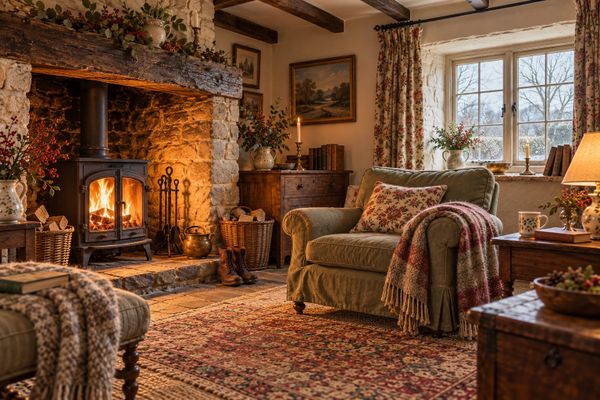
In every holiday cottage listing there is a photograph of a fire, and in every one of those photographs the fire is already going. Not catching. Going. Third log, embers settled, the glass clean, the sort of fire that represents about forty minutes of somebody's close personal attention.
Somebody built that fire. Somebody knelt on that rug with kindling and a sheet of newspaper and spent a quarter of an hour not at all sure it was going to take.
That person is you. You just haven't booked the cottage yet.
This is the single most misread photograph in the whole of British holiday letting, and it is worth learning to read properly, because a cottage that is genuinely warm on a Friday night in February is one of the great pleasures this country offers, and a cottage that is theoretically warm is one of its more memorable disappointments.
Three phrases that mean three different weeks
Wood burner. A stove with a door and a glass front. Efficient, forgiving and still faintly warm at seven in the morning. This is the one you want. A wood burner can heat a room that central heating has given up on, and it will do it while you are in the pub.
Open fire. Beautiful, and roughly as efficient as leaving a window open and setting fire to the curtains. Most of the heat goes up the chimney. I am not telling you to avoid one, because an open fire in a stone inglenook on Christmas Eve is worth any amount of thermodynamic nonsense. I am telling you not to count on it as the heating.
Feature fireplace. There is no fire. There has not been a fire since 1974. There is a fireplace, and it is a feature, and in the photographs it will have pillar candles in it.

And none of the three is the heating. That is the quiet assumption the photograph makes on your behalf, and it is the one worth checking hardest. A great many holiday cottages run on oil, LPG or electric storage heaters rather than mains gas, some of them on a timer somebody else sets, and a building with walls three feet thick does not warm through in an afternoon however well the fire is going. The fire is the evening. The radiators are the week. Find out which you are getting, and if the listing is coy about it, the coyness is the answer.
What "logs provided" is doing
Here is the sentence that decides your first evening.
"Logs provided" means logs. "Starter pack of logs provided" means four logs and a long dark drive back out to a village shop that shut at four. "Logs available locally" means there is a man. You will be looking for the man.
None of these is a reason not to book. They are a reason to know in advance whether you are arriving with a boot full of wood or an evening of optimism.
The thing worth checking, and almost nobody does, is whether the listing mentions kindling. Logs without kindling is a bag of flour without an oven. If it says nothing, assume nothing, and put firelighters in the car.

What central heating never taught me
I grew up with central heating, which means I grew up thinking of heat as something you ask for rather than something you build. You set a number, the building agrees to it, and nobody has to think about the arrangement again until the bill.
A fire does not work like that. What you are managing is air, and the right amount changes through the evening: too little and the fire smoulders, too much and you are through the whole basket by half nine. Nobody explains any of this to you, because everybody who grew up with it learned it at an age where it didn't count as learning.
A fire in this country is not an appliance. It is a small ongoing relationship, and the listing photograph is always taken after the hard part, once the fire has settled and nobody needs to touch it for an hour.
How to tell a working fire from a photographed one
Two tells, both of which are in the photographs you are already scrolling past.
Look for the log store. A woodshed, a stack under a lean-to, a basket by the hearth that is genuinely full rather than arranged. If somebody thought the woodpile was worth photographing, somebody at that cottage takes the fire seriously, and that is worth more than any amount of prose about cosy evenings.

Look at the state of the grate. A spotless hearth with three candles standing in it has not had a fire in it this year. A faint grey dusting, a slightly smoked pane, a bucket with ash in it: somebody was sitting in front of that fire in the last cold spell.
The rest of it is the usual business of reading a listing properly, which applies to the kitchen and the bedrooms just as much as to the fire, and which I have gone through elsewhere: How to read a cottage listing.
What is particular to fire is this: filter for a wood burner on the search page before you look at anything else, rather than scrolling hopefully and seeing what turns up. That narrows the field immediately, and what survives the filter tends to be the kind of place with thick walls, deep windowsills and a kitchen with a proper table in it. Fire is a remarkably good proxy for everything else.
Going out for more wood
The trip to the log store is invariably made after dark, in weather you had not intended to go out in, carrying an empty basket. Oddly, it becomes part of the week.
If there is one thing worth leaving by the back door, it is a pair of boots you can step straight into. The Muck Boot Chore is that sort of boot: it goes on without anybody having to sit down, which is most of the argument for it.

Nobody is coming to light that fire
There is no caretaker who arrives at four on a Friday to get things going, no previous guest who left it banked for you, no photographer's assistant with a flue key.
You are standing in that room in your coat, the grate is cold, the basket somebody filled last Tuesday is by the hearth, and the next half hour decides how the evening goes.
Lighting a fire takes two attempts more often than anybody admits, and then it catches. That is what the photograph leaves out. By nine you are looking at the fire from the listing, except this one is warming the room and you are the one who got it going, and that is the part of the evening people describe afterwards.
Book the one with the wood burner, though. Give yourself a fighting chance.
This post contains affiliate links, which means I may earn a small commission if you book or buy through them, at no extra cost to you. I only recommend places I would happily spend a wet Tuesday in. More on that here.
📌 Pin this for later, because you will be booking a self-catering cottage in January, and you will want the one with the fire.